

125 S. Wacker Drive Buyer Betting on a Chicago Office Comeback
The next chapter of Chicago’s downtown office market is being written by contrarians.
Last week, Menashe Properties, a Portland, Oregon–based real estate investment firm, closed on the purchase of the 31-story tower at 125 S. Wacker Drive for $51.5 million, roughly 64% less than the $145 million paid for it in 2017. The seller, a Canadian pension-fund venture, took the loss as another sign of just how far downtown office values have fallen since 2020.
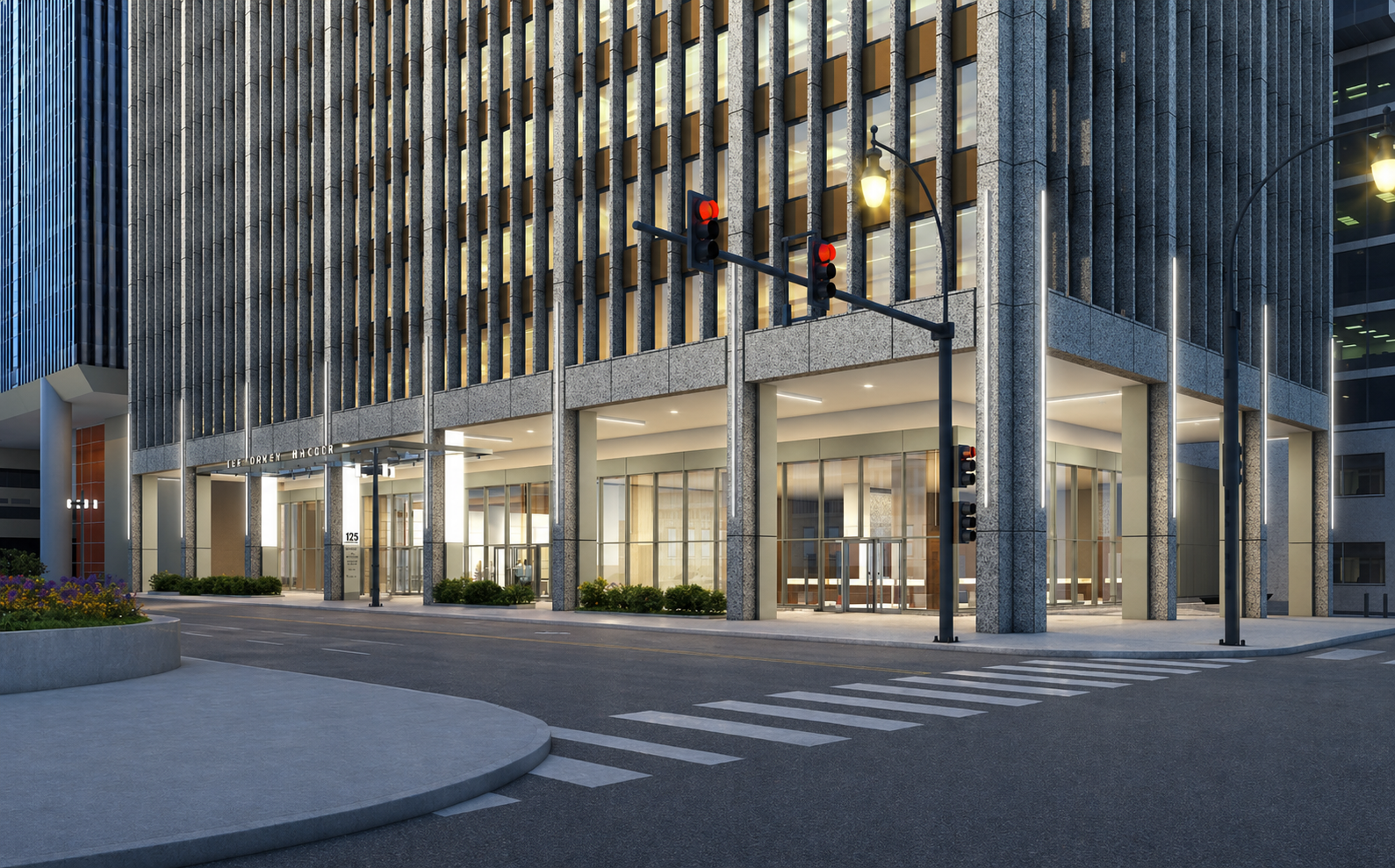
The 576,800-square-foot tower, perched at the northeast corner of Wacker Drive and Adams Street, is a symbol of both distress and opportunity. Once valued among the city’s core institutional assets, the property now represents a new class of investment: office buildings trading at deep discounts to replacement cost.
 Chicago’s Discount Era
Across downtown, office towers continue to change hands at record markdowns. A recent Crain’s analysis found that 22 major properties sold since late 2023 have fetched roughly $2.2 billion less than their combined pre-pandemic valuations.
For Menashe, this is precisely the kind of environment that rewards speed, liquidity, and what CEO Jordan Menashe calls “value rent strategy.” The firm also bought 230 W. Monroe Street two years ago for about 60% less than its 2014 sale price and has since lifted occupancy from 60% to 85%.
“125 S. Wacker is a pure lease-up play,” Menashe said. “The lobby’s done, the amenities are done. We’ll build eight to ten move-in-ready suites faster than most can blink.”
Instead of chasing trophy finishes, Menashe focuses on operational velocity—pre-built suites, flexible terms, and market-driven pricing. The firm’s leasing approach at Monroe delivered more than 50 new deals between renewals and expansions, proof that value-oriented office space still finds demand.
A Contrarian Bet on the Loop
While many institutional owners remain paralyzed by debt or interest-rate pressures, private firms like Menashe are filling the void. The company financed less than half of its Wacker Drive purchase price, working with Obra Capital for acquisition financing and Annenberg Investments as a minority equity participant.
That leverage profile—less than 50%—is conservative by design. In a market where many Class B and C owners face refinancing risk, unlevered or lightly leveraged buyers can underwrite cash-flow stability at rents that undercut distressed competitors.
Menashe calls it the “value rent window,” a fleeting period when supply is high but few landlords can actually transact. “The demand pressure is mounting because there are so few buildings in the mix,” he said. “If you can deliver value to brokers and tenants, you’re leasing space fast.”
This thesis has made 125 S. Wacker a test case for the post-pandemic Chicago office market—a market that increasingly rewards entrepreneurial ownership and fast-cycle asset management over institutional patience.
A Changed Landscape for Office Space
The tower was about 64% leased when it went to market earlier this year, with an average tenant size of roughly 8,000 square feet. Many of its occupants are midsize professional and service firms, the bread-and-butter tenants that still value central access and Class A finishes but are now more rent-sensitive than ever.
The property’s previous owner, the real estate arm of a major Canadian pension fund, had invested more than $21 million in upgrades over the past decade, including a new lobby, refreshed corridors, and amenity enhancements. But despite the capital infusion, rising vacancies, hybrid work trends, and financing headwinds proved too much.
That story isn’t unique to Wacker Drive. It’s playing out in similar buildings across the Loop, where commercial real estate agents report growing demand for “move-in-ready” office suites under 10,000 square feet, while large corporate renewals remain rare.
In this environment, the ability to offer immediate occupancy and competitive rates may matter more than skyline prestige.
The Broader Downtown Equation
Chicago’s office space landscape is undergoing what economists call a “re-pricing of utility.” Once the gold standard of corporate identity, downtown towers are now competing with suburban campuses, hybrid work models, and smaller satellite offices.
Yet the city’s fundamentals, central transit, workforce density, and infrastructure, remain unmatched in the Midwest. That’s why the next wave of investors isn’t walking away; they’re buying back in at 2010-era pricing.
For Menashe Properties, with roughly 7 million square feet of commercial holdings nationwide, that conviction is clear. Its bet is that, by the time interest rates normalize and capital re-enters the market, stabilized assets like 125 S. Wacker will deliver institutional-grade yields without the institutional entry cost.
Could Conversions Follow?
While Menashe has not hinted at plans for an office conversion, the building’s bones, efficient floorplates and a location adjacent to Union Station make it a candidate for future adaptation. City programs such as LaSalle Street Reimagined are already incentivizing mixed-use redevelopment for similarly situated properties.
If absorption fails to keep pace with sublease supply, hybrid office-to-residential conversions could emerge as the next logical phase for vintage Loop towers. But for now, Menashe is all-in on leasing velocity.
What It Means for the Market
The sale of 125 S. Wacker Drive marks a pivotal moment in Chicago’s commercial real estate cycle. It reflects both the pain of repricing and the potential for renewal. Buildings that once commanded trophy valuations are being reintroduced to the market at 50% or 60% discounts—prices that finally make sense for adaptive, mid-market investors.
And while national headlines focus on distress, local tenants are seizing opportunities: newer space, shorter terms, and value rents that were unimaginable five years ago. For brokers, it’s an environment that rewards creativity and speed.
For more on the state of the commercial real estate market, reach out to our team of Chicago commercial real estate brokers.