

Look around, and it is clear that the conversation about returning to the office is no longer about public health. It is about power, culture, cost, and career risk. Underneath all of that sits something more basic: fear.

Executives fear lost productivity, frayed culture, and wasted office space. Employees fear losing flexibility, burning out on their commute, and falling behind if they are not present. If you design your workplace strategy around those fears instead of around data and clear objectives, you get the worst of both worlds. People show up, but engagement, performance, and retention quietly erode.
This post looks at what leaders and employees are actually afraid of, then walks through hybrid models that are already proven to work.
The Reality Check Hybrid Is the New Default
Before talking about fear, it helps to ground in what is actually happening.
Global research shows work from home has stabilized worldwide rather than returning to 2019 patterns. The Proceedings of the National Academy of Sciences published a 2025 study showing that remote work has persisted and is reshaping urban economies.
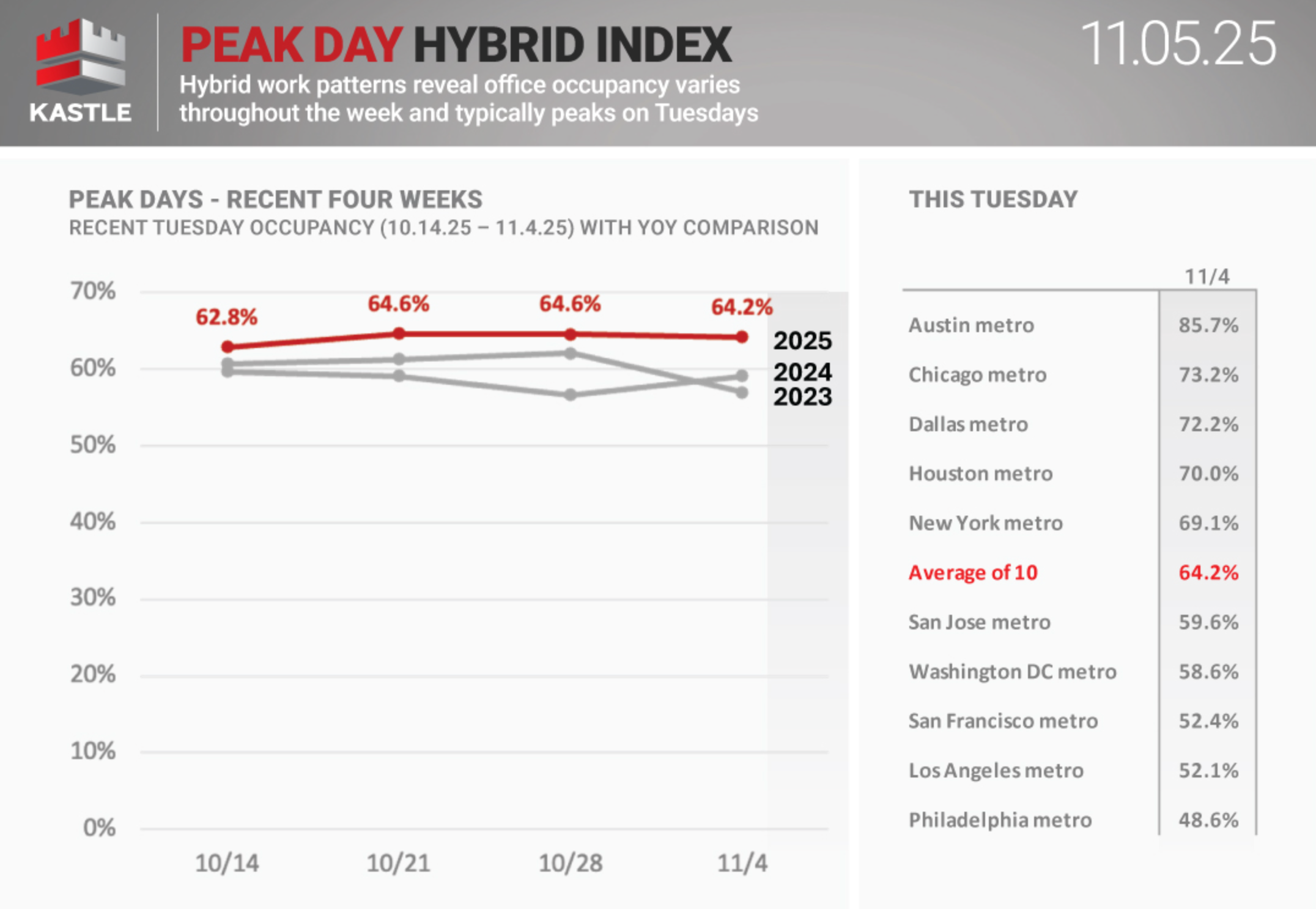
In the United States, office occupancy has plateaued. Kastle Systems badge swipe data shows attendance averaging around half of pre-pandemic levels across major cities.
Gallup finds that in remote-capable roles, 52 percent of employees are hybrid, 26 percent are fully remote, and 22 percent are fully on site.
Stanford’s 2025 survey of executives reports that only about 12 percent of leaders plan a full return to office requirement.
If hybrid is already the dominant model, why are organizations still fighting about where people sit The answer is fear on both sides.
What Leaders Are Afraid Of
Fear of Productivity Loss
Executives often believe productivity drops when people are not colocated. The evidence is more nuanced.
A Stanford working paper shows that fully remote work can reduce productivity by about 10 percent on average due to communication friction and weaker mentoring. But the same body of research shows that hybrid one to three days per week in the office does not create this effect. Trip.com ran one of the largest randomized controlled trials on hybrid work. Employees worked from home two days per week and in the office three days.
- No drop in performance ratings
- Quit rates dropped by one third
- Job satisfaction increased significantly
The conclusion is simple. Fully remote requires careful design to maintain coaching and communication. A hybrid work strategy has little to no productivity penalty when organized deliberately.
Fear of Losing Culture and Innovation
Many leaders worry that culture will decay without constant in-person presence. There is truth here. Early career employees benefit from proximity.
Research summarized by the New York Times shows that young workers who rarely spend time in the office miss critical informal learning.
However, culture is not determined by geography alone. Gallup reports that manager quality and role clarity influence engagement almost four times more than whether someone works remotely or in person.
If your culture hinges on mandatory presence, it is not a robust culture; it is a fragile one.
What Employees Are Afraid Of
Fear of Losing Flexibility and Control of Their Day
Hybrid work reclaimed hours of commuting time. That is not trivial. It is one of the biggest productivity gains in modern labor history.
Research by Barrero, Bloom and Davis estimates that the elimination of commute time contributes a 4 to 5 percent productivity boost nationally.
Employees fear that mandatory office policies take those reclaimed hours and hand them back to traffic.
Fear of Unequal Treatment and Invisible Penalties
Many employees accept hybrid but fear subtle career penalties. This fear is not imaginary.
Reports from CNBC and Harvard Business Review note that remote workers, especially women and caregivers, are more likely to experience slower promotion cycles or reduced access to mentoring.
Employees fear being quietly sidelined simply because they are not always physically present.
Fear of Unclear Expectations
The Associated Press reports that nearly half of US workers are unclear on basic performance expectations in a hybrid environment.
Unclear expectations increase anxiety regardless of where the person sits.
Hybrid Models That Actually Work
Two to Three Anchor Days in the Office
The Trip.com experiment is one of the strongest examples we have. Three days in office, two at home.
Results:
- No loss in performance
- Thirty three percent reduction in attrition
- Higher job satisfaction
Again, published in Nature.
Gallup data also shows two to three office days is the most common and most desired schedule among hybrid workers.
Outcome Based Management Instead of Seat Based Management
Across more than a decade of data, Gallup finds that leadership quality, recognition and clarity matter far more than where people sit.
High performing hybrid organizations use:
- Clear objectives and key results
- Weekly one to one check ins
- Transparent promotion criteria
- Strong digital collaboration tools
They do not rely on hallway visibility.
Deliberate Design for Early Career Talent
Younger workers need structured in person time. What fails is requiring them to commute in for nothing but Zoom calls.
Best practices include:
- Shared team days for juniors and seniors
- Live feedback sessions and shadowing
- In-person collaboration only when needed
- Remote-first digital tools so remote employees are not excluded
Research highlighted in the New York Times confirms that role modeling and proximity matter most for early career development.
Balancing Risk Instead of Chasing Certainty
Fear driven strategies try to eliminate risk entirely. That is not realistic. You are choosing which risks to accept.
- Fully remote without structure risks communication friction, lost mentoring, and slightly lower productivity in certain roles.
Source: Stanford WFH Research - Mandatory five day office weeks risk higher attrition, weaker hiring pipelines, and lower engagement. Controlled studies show hybrid reduces quit rates by one third.
Source: Trip.com RCT
Hybrid is often the best balance. It preserves collaboration and culture while protecting flexibility and morale.

A Simple Gut Check for Leaders
Three questions reveal whether fear is guiding your strategy:
- Can you clearly explain why each office day exists and what work is supposed to happen on those days
- Do you have actual productivity, engagement, or retention data by work arrangement, or are you relying on anecdotes
- Have you asked employees what they fear and what helps them perform at a high level
If the honest answer is no, uncertainty and fear are guiding you more than evidence.
The organizations that win the next decade will not be the ones with the strictest badge scans. They will be the ones who use data, design hybrid systems intentionally, and build cultures where people know what good work looks like wherever it happens.
If your interested in how your can improve thier space or strategy to improve the return to office process, reach out to our team of commercial real estate agents!