

Chicago’s First Vertical Warehouse Hits the Market — Empty. What It Means for Industrial Real Estate
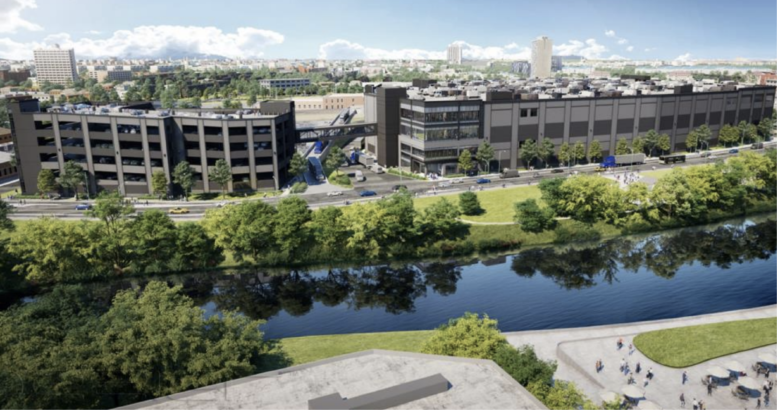
When Logistics Property Company broke ground on Chicago’s first multi-story industrial warehouse, the project was hailed as the future of urban logistics. Rising five stories on Goose Island and offering more than 1.2 million square feet of industrial and structured parking space, the building was meant to prove that vertical logistics could finally take root in the Midwest.
But a year after completion, the building remains empty. Now officially listed for sale and lease, Chicago’s first vertical warehouse is becoming something of a Rorschach test for the city’s industrial market, a mirror reflecting both its strength and its limits.
A Landmark Project with a Puzzling Outcome
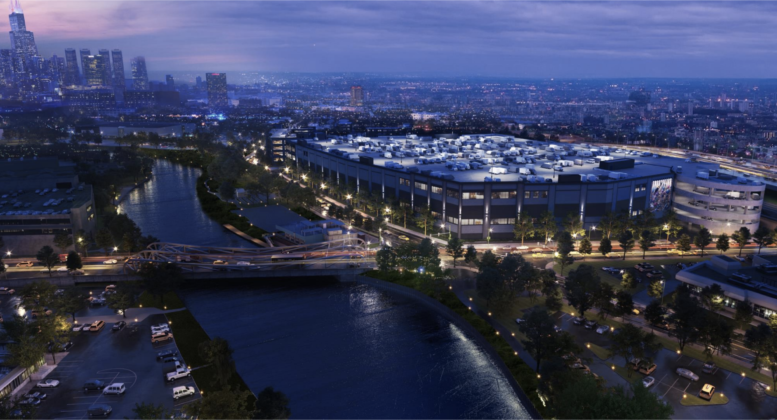
Located at 1237 West Division Street, the building was conceived as a bold experiment: an infill, urban-core distribution hub with the density and efficiency of a modern high-rise.
Developers invested heavily, over $55 million for the land and roughly $150 million in construction financing, according to The Real Deal.
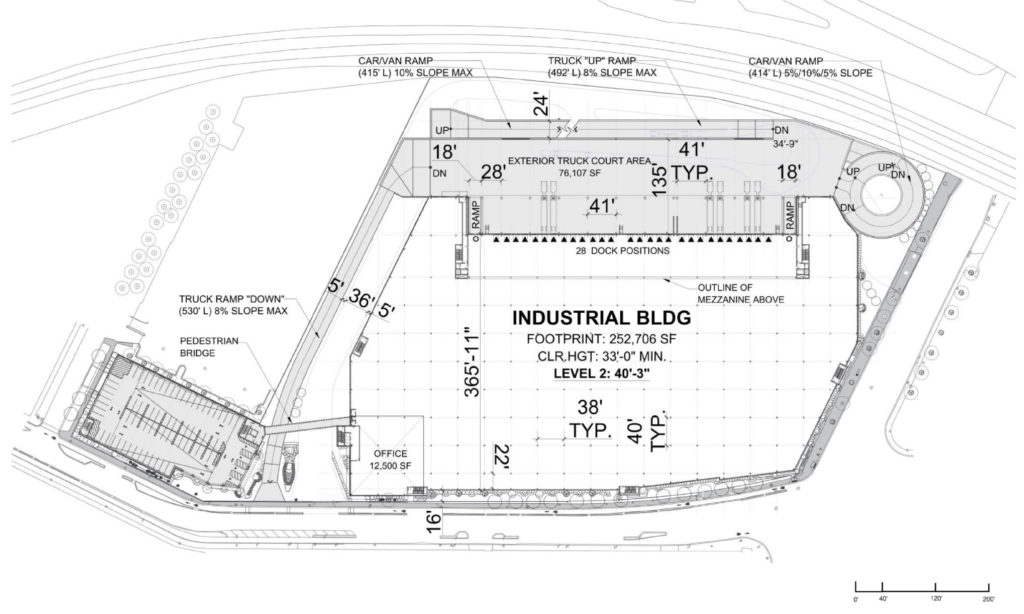
The design features two levels of warehouse space totaling about 571,000 square feet, topped by three levels of structured parking and loading areas. It’s an architectural first for Chicago, modeled after the multi-level distribution centers that have become common in Tokyo, Hong Kong, and parts of New York City.
Despite those innovations and despite Chicago’s industrial vacancy rate sitting at a healthy 5.9% (well below the 7.5% national average) the property has yet to secure a single tenant.
JLL, which is now marketing the property, is positioning it as a premier urban logistics or data-center-ready opportunity for lease or sale. Still, the absence of tenants raises larger questions about what kind of demand today’s industrial users actually want and what they’re willing to pay for.
What the Empty Vertical Warehouse Says About the Market
Chicago’s industrial sector has been one of the strongest in the nation for the last decade. The region’s logistics network, labor pool, and relative affordability have made it a magnet for e-commerce, food distribution, and advanced manufacturing.
Yet the Goose Island project exposes some structural challenges that even a tight market can’t paper over. It’s not that industrial demand has dried up; it’s that the product type may not match what tenants need.
1. Speculative Development Is Losing Momentum
This building was delivered 100% spec, meaning no tenant commitments before completion. That approach worked during the e-commerce surge of 2021–22, when demand far outpaced supply.
But in 2025, financing costs are higher, absorption is slower, and lenders are tightening underwriting standards. The fact that this flagship project is still vacant underscores a broader shift: the market now rewards developers who pre-lease or design for specific tenant requirements.
2. The Vertical Model Is Still Unproven in the Midwest
In land-constrained coastal cities like New York and Seattle, vertical industrial design makes sense; land values justify the added cost and complexity. But in Chicago, where developable land is still relatively available in suburban corridors (Elk Grove, O’Hare, I-55, I-80), tenants tend to prefer single-story facilities with easy truck access.
The vertical format adds costs for ramping, structural loading, and freight systems, features that many tenants may not value unless there’s a pressing need for proximity to downtown or same-day delivery networks.
3. Capital Cost Pressures Are Real
The economics of vertical industrial construction are unforgiving. Between land, concrete, steel, and debt, the cost per buildable square foot can easily exceed $300, double that of a traditional suburban warehouse.
Unless rents approach $25–30 per square foot, which is aggressive for Chicago, the math becomes challenging.
The result? Even with low vacancy and rising demand for infill locations, developers face thinner margins and slower lease-up timelines.
Why This Isn’t All Bad News
Despite the project’s struggles, the underlying fundamentals of Chicago’s industrial market remain robust. In many ways, this vacancy highlights discipline rather than weakness, proof that tenants and investors are making rational, data-driven decisions in an evolving market.
1. Demand for Infill Space Is Still There
Last-mile logistics, cold storage, and light manufacturing operators still need space within reach of Chicago’s 9.5 million consumers. The question isn’t whether they’ll lease infill sites, it’s whether they’ll pay the premium for vertical design. As space constraints intensify along the O’Hare corridor, that calculus may eventually shift in favor of multi-level facilities.
2. This May Accelerate Product Segmentation
Expect developers to become more strategic. Instead of one-size-fits-all “vertical warehouses,” we’ll likely see smaller, two-story prototypes, or hybrid structures blending warehouse, office, and showroom space.
Projects that incorporate data center infrastructure, AI robotics, or EV logistics integration could bridge the gap between industrial and tech sectors both hungry for power, proximity, and adaptability.
3. Urban Industrial Remains a Long-Game Play
Infill development in Chicago isn’t going away; it’s just maturing. As zoning and infrastructure evolve, vertical industrial could eventually make economic sense, especially near rail or ports.
But for now, traditional horizontal industrial remains the preferred model for users balancing cost, access, and functionality.
What This Means for Investors and Developers
For investors, the Goose Island project is a case study in timing, not failure. It shows where capital and creativity can get ahead of tenant behavior.
For developers and brokers, it’s a reminder that even in a strong market, alignment between product and user is everything. Chicago’s industrial market isn’t oversupplied; it’s sorting itself into sub-segments defined by cost tolerance, logistics function, and location sensitivity.
For city planners and policymakers, the lesson is equally clear: density and innovation are necessary, but incentives and infrastructure need to evolve in parallel. Without better truck routing, utility upgrades, and zoning flexibility, vertical industrial will remain a niche solution.
Outlook: Strength, Not Saturation
Chicago’s industrial sector continues to outperform most major metros, with stable vacancy, sustained rent growth, and rising institutional ownership. The vertical warehouse may be a warning against speculative exuberance, but it’s not a sign of weakness.
If anything, it underscores the market’s maturity: investors are smarter, tenants are choosier, and the bar for what qualifies as “prime industrial space” keeps rising.
Whether the Goose Island project finds its tenant or changes hands, it has already served its purpose, forcing the market to ask better questions about where industrial real estate goes next.
For more on Chicago industrial space, reach out to our team of Chicago Commercial Real Estate Agents.