

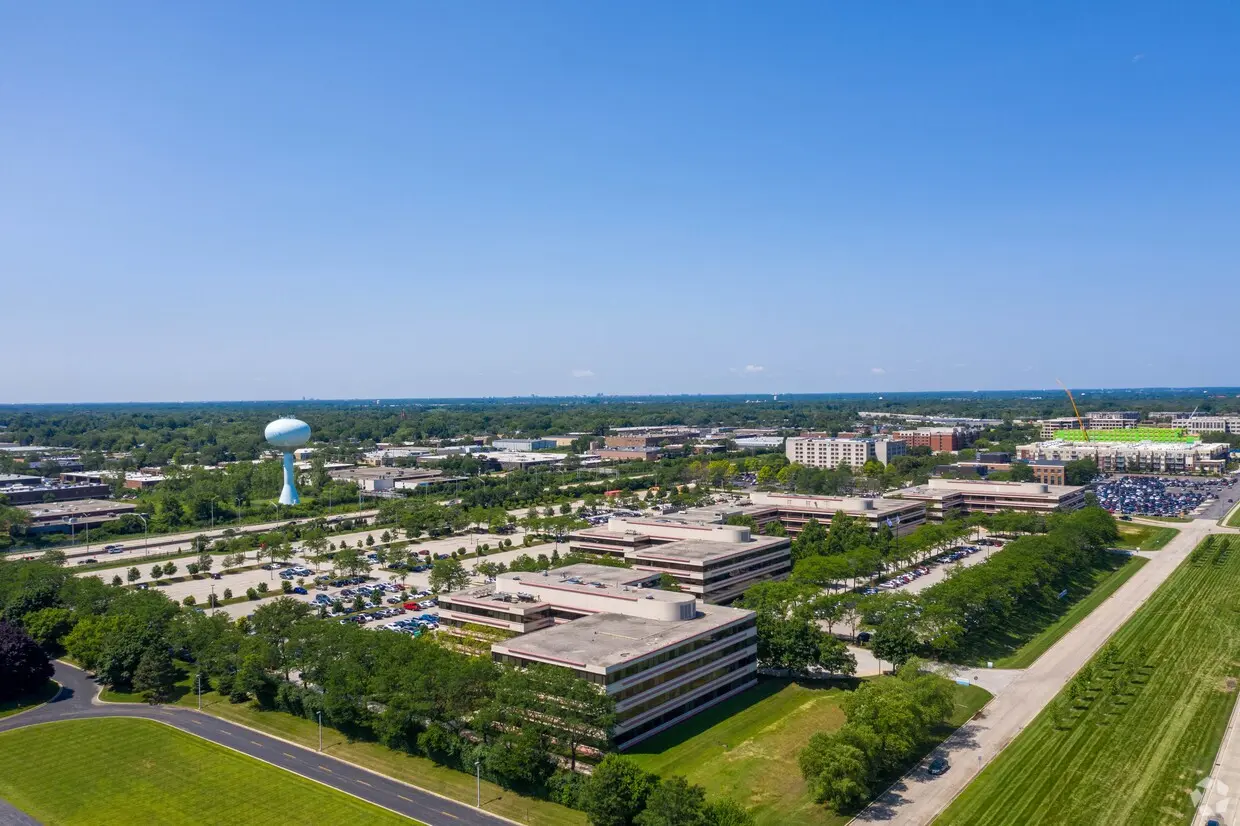
The suburban office reckoning continues. In Deerfield, Orion Office REIT has made the decision to demolish the long-empty former Walgreens campus at 1411–1435 Lake Cook Road, a 575,000-square-foot office complex sprawled across 37.5 acres. What was once a symbol of corporate stability is now a casualty of changing work patterns, rising interest rates, and a sluggish market for outdated suburban campuses.
Orion is spending about $500,000 to clear the buildings, hoping the reset will make the site more attractive to buyers after a previous redevelopment deal fell apart. The property, valued at just $11.1 million on Orion’s books, down dramatically from Walgreens’ $85 million sale-leaseback in 2013, which underscores how much value in the local office space market has already evaporated.
For Orion as the owner, the decision is not simply about demolition. It’s a strategic bet on whether removing a visibly obsolete asset creates more opportunity than holding on to what’s left. Below, we break down the positives and negatives from the owner’s perspective and why, paradoxically, sometimes even keeping an eyesore in place can be an advantage.

Positives for Orion as the Owner
1. Carrying Costs Drop
Even a vacant office campus is expensive to hold. Security guards, utilities, insurance premiums, and basic maintenance add up each year. For Orion, demolishing the property reduces these ongoing costs significantly. A cleared lot is far cheaper to maintain than a half-million square feet of aging structures prone to leaks, vandalism, and code compliance headaches.
2. Improved Marketability
When potential buyers or developers drive by the site, a clean slate allows them to imagine possibilities: residential communities, retail and entertainment hubs, senior housing, or even a data center. Selling a shovel-ready site is often easier than selling an obsolete office complex requiring demolition anyway. By absorbing that cost upfront, Orion positions the property to appeal to a wider pool of buyers.
3. Strategic Reset on Value
The property’s value has already been written down so significantly that the demolition is almost a sunk cost strategy. Orion spent relatively little compared to the capital required for renovation or speculative redevelopment. At $500,000, the demolition is a fraction of what a retrofit or conversion might cost. Clearing the site creates optionality without a major new investment.
4. Aligning With Market Reality
The suburban Chicago office market is oversupplied and struggling. Vacancy rates are high, and large corporate campuses are out of favor. By acknowledging the property will not succeed as office space, Orion avoids the trap of throwing good money after bad. Demolition signals a realistic approach aligned with current demand trends.
Negatives for Orion as the Owner
1. Capital Loss Locked In
By choosing demolition, Orion concedes that the buildings, once worth tens of millions, now have zero economic value. The $85 million Walgreens once realized in a sale-leaseback deal in 2013 is history. For Orion, the demolition underscores the magnitude of the capital destruction. It’s one thing to mark down values on paper, another to literally erase the asset from the landscape.
2. No Income During the Interim
A vacant office building, while costly, still has potential upside if a tenant is found, even temporarily. Once demolished, the site produces no rent until redevelopment occurs. For Orion, this creates a “dead zone” on the balance sheet: land that incurs holding costs but generates nothing.
3. Uncertain Redevelopment Timeline
Clearing the land does not guarantee a buyer or project. Financing for large-scale development remains tight, particularly for mixed-use office conversion projects in suburban locations. The prior redevelopment plan with LG Group collapsed under interest rate pressure. Orion could be left with a vacant site for years, during which the carrying costs, though lower, still chip away at returns.
4. Lost Opportunity for Adaptive Reuse
Not every outdated office complex is hopeless. Across the country, some owners are repurposing suburban offices into medical space, schools, or residential conversions. By demolishing, Orion eliminates any chance, however slim, that the existing structures could be repurposed creatively. The “office conversion” playbook has challenges, but it also has success stories.
The Curious Case for Keeping an Eyesore
Demolition is often positioned as the obvious solution to an obsolete property. But there is a paradox in real estate: sometimes even an eyesore has strategic value.
A decaying office complex can serve as a visual reminder of conversion redevelopment potential. For certain developers, seeing an underutilized but standing structure makes the case for change more compelling. In some cases, municipalities or neighbors may even become more motivated to support rezoning or tax incentives when a visible eyesore lingers.
Additionally, vacant structures sometimes create opportunities for temporary income streams, including leasing to film studios, storage operators, or short-term tenants who don’t require modern finishes. While not lucrative, those arrangements can offset costs while owners line up longer-term redevelopment.
By demolishing, Orion sacrifices the potential leverage of having a visible problem to solve, though in this case, management clearly decided that the costs outweighed any symbolic or temporary benefits.
What It Signals for the Office Market
From an ownership standpoint, the Deerfield demolition is another data point in a market where landlords are openly admitting that certain office spaces are not just vacant but fundamentally obsolete.
-
Office Space Demand Has Shifted Permanently
Hybrid work has reduced the need for large footprints. Companies prefer efficient, amenity-rich office space, not sprawling 1980s campuses. -
Flight to Quality Leaves Older Stock Behind
Class A buildings near transit or with strong amenities still attract tenants. Class B and C suburban properties are increasingly viewed as teardown candidates. -
Valuation Gaps Are Exposed
The dramatic fall from $85 million in 2013 to an $11 million book value in 2025 demonstrates how quickly office valuations can erode when demand dries up.
What It Signals for Office Conversions
For office conversion strategies, the Deerfield property underscores an important lesson: not every office can be saved…
-
Conversions Work Best in Urban Cores
Downtown assets with proximity to transit, smaller floor plates, and vibrant surrounding neighborhoods lend themselves to residential or mixed-use conversions. -
Suburban Campuses Pose Unique Challenges
Buildings with deep footprints, outdated systems, and car-centric layouts are difficult and costly to adapt. In these cases, demolition is often more practical. -
Demolition Becomes a Form of Conversion
In today’s climate, clearing a site is effectively an “office conversion” strategy. The land itself is the asset, not the building. For Orion, that means resetting the narrative from office space woes to land opportunity.
The Owner’s Balancing Act
For Orion, the decision to demolish reflects a pragmatic calculation:
-
Keep the buildings, and the property remains an expensive eyesore with little market appeal.
-
Tear them down, and the property may be easier to sell, but with no guarantee of near-term income.
In this equation, Orion chose to accept the write-off, reduce costs, and improve optionality. Yet the story also highlights the difficult balancing act owners face in today’s market: sometimes the worst-looking assets still have hidden value, and sometimes clearing the slate is the only way forward.
Conclusion
The demolition of the former Walgreens campus in Deerfield is more than a local real estate story; it is a case study in the trade-offs facing today’s office landlords. For Orion, the positives include lower carrying costs, improved marketability, and alignment with market reality. The negatives are equally stark: permanent capital loss, no interim income, uncertain redevelopment, and elimination of adaptive reuse potential.
Most importantly, it illustrates a sobering truth about suburban office real estate: the market is no longer forgiving of outdated assets. While some office buildings can be creatively converted, others are simply destined for the wrecking ball. For owners like Orion, the decision comes down to a blunt calculation: when does an eyesore stop being leverage, and when does it simply become dead weight?
For more on the Deerfield real estate market, reach out to our team of local agents!