

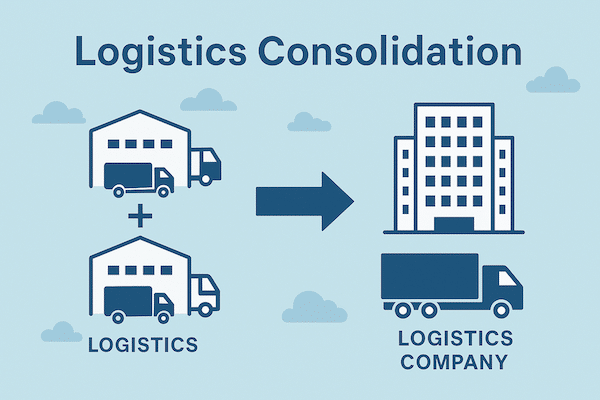
Over the last decade, the logistics industry has undergone a rapid transformation, driven by e-commerce, supply chain digitization, and shifting global trade patterns. But beneath the surface of tech adoption and warehouse expansion lies a deeper trend reshaping the entire ecosystem: consolidation.
From third-party logistics (3PL) providers merging with freight brokers to transportation management systems absorbing warehousing software, consolidation is creating fewer, larger, and more vertically integrated logistics players. And while this may lead to efficiency gains and pricing power for logistics providers, it also brings significant implications for commercial real estate.
In this article, we’ll explore how consolidation in logistics is reshaping site selection, leasing decisions, property valuations, and tenant-landlord relationships across the industrial real estate sector—and what it means for brokers, developers, and commercial real estate companies.


Fewer Tenants, Bigger Requirements
As logistics firms merge and expand, their facility needs grow accordingly. The era of the 50,000-square-foot standalone regional warehouse is giving way to massive 500,000+ square foot distribution centers. These aren’t just larger, they’re smarter, tech-enabled, and often multi-functional.
For commercial real estate professionals, this means one thing: a shrinking tenant pool, but with more complex and valuable requirements. A market that once accommodated dozens of small logistics operators may now serve just a handful of large players, all competing for limited Class A industrial space with high clear heights, trailer parking, and proximity to intermodal infrastructure.
Brokers and landlords who understand these changing specs and can deliver spaces that match them stand to benefit. But for outdated or inflexible assets, the field of viable tenants is narrowing.
Demand for Speed, Scale, and Control
Consolidated logistics firms often prioritize speed and scalability in site selection. Whether it’s a third-party logistics provider expanding its footprint or an e-commerce retailer internalizing its supply chain, the goal is to serve as much population as possible, as fast as possible.
This drives demand for infill locations near major metropolitan areas, interstates, and airports—areas where land is scarce and zoning is restrictive. As a result, redevelopment of older industrial or even office and retail sites is becoming more common. In some markets, we’re already seeing converting office buildings into logistics-adjacent uses like delivery hubs, micro-fulfillment centers, or flex industrial spaces.
Control is also a major factor. Many of the largest consolidated logistics firms prefer ownership or long-term leases with customization rights. This has increased interest in build-to-suit opportunities, sale-leasebacks, and other flexible capital structures.
More Creditworthy but Also More Demanding Tenants
One upside of consolidation is that landlords now deal with more creditworthy tenants. Publicly traded or private equity-backed logistics firms are typically better capitalized, making them attractive occupants from a risk perspective.
However, these tenants often have significant bargaining power. They negotiate longer leases but push harder on TI allowances, rent escalations, and expansion clauses. They also expect more from the spaces they occupy from ESG certifications to EV truck infrastructure and smart building systems.
Commercial property owners who adapt to these demands can command premiums, but those who don’t may be left behind.

Flex Space and Micro-DCs in High-Traffic Nodes
Not all the impact is happening at the mega-scale. In dense urban areas, consolidation is creating demand for micro-distribution centers—often 10,000 to 30,000 square feet—in close proximity to consumers.
These facilities are essential to same-day delivery networks and often involve creative reuse of existing buildings. In some cities, this includes converting office buildings or underused retail strip centers into last-mile logistics hubs.
This trend opens opportunities for developers and investors to reposition assets that might otherwise struggle in today’s market. It also puts pressure on zoning and municipal planning departments to allow more flexible uses in urban cores.
What It Means for Commercial Real Estate Companies
For commercial real estate companies, logistics consolidation demands a new playbook. Success in the industrial sector no longer comes from listing a vacant warehouse and waiting for a local operator to sign a lease. It requires strategic planning, data-driven insights, and national relationships with decision-makers at major logistics firms.
Brokerage teams must understand not just square footage needs but operational flow, labor access, and network modeling. Developers must be able to execute at scale and with speed. Property managers must accommodate more complex buildouts and automated equipment within their maintenance plans.
And most importantly, investors must accept that industrial real estate today is no longer a passive asset class. The tenants are sophisticated, the leases are tailored, and the competition is fierce.
Looking Ahead
As logistics consolidation continues both among traditional 3PLs and e-commerce-native players, the demand for high-quality, strategically located industrial real estate will only grow. But that growth won’t be evenly distributed. It will go to the landlords, developers, and brokers who understand the evolving needs of the industry and can deliver solutions that go beyond square footage.
Chicago, with its multimodal infrastructure, central location, and large population base, is particularly well-positioned to benefit. But that potential will only be unlocked by stakeholders who act proactively through acquisitions, redevelopment, and strategic tenant partnerships.
And if you’re looking for someone who can help you navigate those decisions, find the right opportunities, and structure deals that create long-term value, that’s where a trusted commercial real estate agent comes in.
Sign Up For A Free Consultation